Summary, Jose V. Benavides
Innovative and results-oriented professional with over 20 years of experience in embedded systems, robotics, aeronautics, and space systems. Proven ability to lead cross-functional teams in both research and operational environments. Adept at managing complex projects from conception to completion.
Contact: Jose.V.Benavides@NASA.gov | NASA Ames Research Center, Intelligent Systems Division | Mountain View, CA
Personal: Jose.V.Benavides@k6wlr.com | Chandler, AZ
Short Resume: PDF/TXT
Experience
NASA Ames Research Center - Computer Engineer
July 2018 - Current, Mountain View, CA
In the years I’ve been a civil servant at NASA Ames, I’ve consistently been evaluated as “Substantively Exceeds Expectations”. I have continued to manage the Astrobee Facility project. Astrobee is a free-flying robotic platform for conducting Intra-Vehicular Activities (IVA) inside of ISS. The Astrobee Facility is an important shared platform on ISS for conducting both fundamental research (i.e., fluidic sloshing dynamics) and higher TRL level technology development needed for deep space exploration. It is a project tasked primarily with maintaining and sustaining this platform in the service of its various users. This also includes providing training and integration support in both the technical development and the overall ISS Program Payload integration process. The many Astrobee users come from academia, government, and private industry.
- We have been responsive to Payload Developer schedules for On-orbit Test Sessions. Some delays have resulted from planning product development and crew time shortages, but we’ve adapted to meet user expectations.
- Project costs were within expectations for FY2023.
-
Supported users include the following:
- MIT with three investigations: SPHERES-Reswarm, ROAM, and Zero Robotics.
- JAXA with a joint Astrobee and Int-Ball free flyer activity on ISS in 2021, Kibo Robotic Programing Challenge (Kibo-RPC-2) (midway through year 3)
- Astrobotic Inc./Bosch with SoundSee on Astrobee
- Naval Post Graduate School with Astrobatics on Astrobee
- Stanford with the Gecko-Inspired Astrobee gripper
- NASA-AES Logistics Reduction REALM-2 with RFID scanner on Astrobee
- NASA’s ISAAC STMD project
- FIT’s SVGS vision navigation project
- SOARS
- Cubee/CLING
-
New Business/development
- I’ve led the Astrobee network communications pipeline integration and testing. This has involved coordinating requirements, testing, server administration, and scheduling ISS program services. In this POP, we’ve assessed a new, hardware-in-the-loop testing capability utilizing an ISS Program tool call RAPTR.
- Coordinated integration with the ISS Imagery Working Group to ensure proper video routing and archiving for Astrobee operations
- Actively support Astrobee test session operations with activity logging, telemetry monitoring, answering questions, procedure tracking, time-line monitoring
- Tracking updates to the Astrobee Interface Control Document (ICD) or Guest Scientist Guide document (GSP)
-
coordinating a new Astrobee payload called SOARS. It’s an STTR funded effort to research fluid transfer mechanisms in micro-gravity.
-
SBIR/STTR work
- I Oversee multiple phase I’s and phase II’s SBIR contracts as Techincal Monitor or COR
- I am the “Z5.04 Technologies for Intra-Vehicular Activity Robotics” Topic and Subtopic Manager in 2020, 2021, 2022, and 2023
- I successfully completed the SBIR phase 1 and phase 2 reviews for 2023.
As a project manager, I’ve gained the experience and skills needed for supervising employees, identifying strategic objectives, defining, and assigning work/milestones, evaluating accomplishments, and recommending employee recognition. I feel strongly that I’ve frequently and consistently demonstrated the competencies of Planning, Problem Solving, Teamwork, General Engineering, Project Management, Technical Competence, Technical Management, and Leadership.
MCT Inc./SGT Inc./IHMC - Research Engineer, NASA Contractor
January 2008 – June 2018 | Mountain View, CA
In 2008, I joined the NASA Ames Research Center Adaptive Control and Evolvable Systems (ACES) group as a contractor for MCT Inc. This NASA Ames (ACES) group is under the Intelligent Systems Division (Code TI) of the Exploration Technology Directorate. The primary focus of the NASA Ames (ACES) group is on fundamental and applied research and technology development in the field of intelligent adaptive systems. Additionally, ACES conducts research, develops, implements, tests, and delivers next-generation control architectures and avionics hardware. The core competency within the group spans across various intelligent guidance, navigation, and control technologies as well as avionics hardware and software system disciplines. ACES conducts foundational and applied research in adaptive, robust, and optimal control, trajectory guidance and planning, avionics architectures and processes, and evolvable systems towards automated design.
From 2008 through 2011, I worked on the development and integration of modeling, simulation, and control capability for hypersonic aircraft or Reusable Air-breathing launch Vehicles (RALV). More specifically, work involved;
(1) Development of models and associated control algorithms, analysis tools and design methodologies that permit the design of Highly Reliable Reusable Launch Systems (HRRLS) which offer robust dynamic performance in the presence of significant uncertainty by exploiting real-time measurements and available control actuators, (2) Integration of control relevancy into the overall vehicle conceptualization, sizing, and design process. This integration is done by incorporating control-relevant dynamical objectives (e.g., performance, robustness).
This work had a significant impact and benefited NASA as a whole by continuing to mature the technology of air-breathing hypersonic vehicles. Air-breathing hypersonic propulsion is viewed as the next critical step toward achieving (1) reliable, affordable, routine access to space, as well as (2) global reach vehicles. Both of these objectives have commercial as well as military implications. While rocket-based (combined cycle) propulsion systems are needed to reach orbital speeds, they are much more expensive to operate because they must carry oxygen. This is particularly costly when traveling at lower altitudes through the troposphere (i.e., below 36,156 ft). Current rocket-based systems also do not exhibit the desired levels of reliability and flexibility (e.g., airplane like takeoff and landing options). For this reason, much emphasis has been placed on two-stage-to-orbit (TSTO) designs that involve a turbo-ram-scramjet combined cycle first stage and a rocket-scramjet second stage. This work focuses on control challenges associated with scramjet-powered hypersonic vehicles. Such vehicles are characterized by significant aero-thermo-elastic-propulsion interactions and uncertainty.
Completed tasks include:
- Reverse engineered and re-implemented the flight mechanics of a high-fidelity take-off to landing general transport flight simulator called FLTz
- Validated and debugged engineering code for computation of aerodynamic, structural, and engine dynamics
- Researched and implemented various control system architectures to generated HRRLS non-linear model
The Tactical Guidance System subtask is directed at developing and evaluating Tactical Flight Management System (T-FMS) technologies that incorporate guidance planning concepts to improve the resiliency and robustness of Trajectory Based Operations (TBO) when operating: (1) in the highly constrained and dynamic environment of the next generation air transportation system (NextGen); and (2) under damaged and/or failure conditions that result in reduce flight and maneuvering envelope constraints. Improvements have been evaluated in terms of improved constraint compliance, reduced occurrences of mode confusion, and increased situational awareness of what the automation is doing now and what it is going to do in the future. T-FMS is an example of an advisory and decision support systems.
Completed tasks include:
- Developed and implemented lateral, vertical and speed path and mode transition prediction algorithms
- Developed and implemented navigational Vertical Situation Display (VSD) for use in a next-generation flight deck concept
- Studied and utilized existing autopilot and navigational system algorithms used for general transport aircraft
- Integrated tactical guidance system and associated capabilities into the Advance Concept Flight Simulator (ACFS) in support of a T-FMS experiment
- Executed lead role in ensuring the T-FMS experiment implemented the new and substantially improved predictive algorithms successfully
- Incorporated reduced flight and maneuvering envelope constraints into the tactical guidance system
- Executed TFMS experimental study in the Advance Concept Flight Simulator (ACFS)
- Evaluated TFMS concepts in a realistic air traffic control (ATC) scenario
- Analyzed the role of automation in air traffic management (ATM) systems
- Expanded and substantially improved a software framework used for inter-process communication between flight simulation applications and telemetry logging.
- Managed and maintained the resources for the NEL flight simulation lab, a critical facility used for prototyping and developing T-FMS.
DARPA has funded the development of 7 micro-gravity free-flyers (called SPHERES: Synchronized Position Hold Engage Reorient Experimental Satellites) at M.I.T., three of which have been periodically operational inside ISS since 2006. NASA has designated SPHERES as part of the ISS National Lab and makes them available for research use. I lead and manage the engineering team that maintains and supports the SPHERES facility. My team and I work with users to test user code to control SPHERES in simulation before uploading the code to ISS for operation on SPHERES, to debug problems, provide ground support during ISS operations, and provide SPHERES telemetry data to users after each test session.
I am ultimately responsible for the following tasks;
- Support configuration management of SPHERES software
- Develop and implement software requirements
- Develop software tests ranging from unit tests to system scenario tests
- Implement and demonstrate the SPHERES 6-DOF software simulator (Matlab) and models
- Provide technical support for all SPHERES test sessions on ISS (6 per year est.)
- Create procedures and certification documents needed for replenishing SPHERES batteries on the station
- Analyze and document SPHERES system-wide assets and limitations in preparation for possible future revisions
- Analyze, design, modify, and integrate next-generation SPHERES concepts
- Supported payload investigations into small satellite automation systems
- Researched multiple systems and algorithm concepts related to satellite navigation theory
- Provide real-time operations engineering support for over eighty ISS astronaut-operated SPHERES test sessions
- Coordinating with the ISS Program Integration Manager (PIM) and Research Integration Manager (RIM) on various safety, verification, and operations products required by the ISS Program.
In July of 2013, I became the Engineering Manager for the for the International Space Station SPHERES National Laboratory. This management position involved leading a team of five engineers responsible for maintaining the SPHERES Facility.
I became a NASA Ames IPA in Nov. 2014. My responsibilities were as follows:
- Provided engineering leadership for the NASA ISS SPHERES Facility
- Formulated agency-wide initiatives (including defining requirements) for small-satellites and/or robotic free-flyer missions
- Represented and advocated for NASA Ames interests in agency-wide meetings and negotiations
- Actively participated in technology maturation and infusion to spaceflight missions, including the ISS
- Led research and development teams in small-satellites and robotic free-flyers
- Managed multiple teams in direct support of flight payload operations and ground testing of ISS experiments at the SPHERES and Astrobee testing Facility at NASA Ames.
- Executed and directed the technical planning, resource management, and facility procedures and processes
- Managed three NASA Ames laboratories responsible for the ground performance testing of SPHERES and Astrobee along with the responsibility for the building of flight quality hardware destined for ISS flight operation
- Ensured the SPHERES and Astrobee labs comply with Agency and Center policies for safety and quality
- Presented bi-annual performance reviews presented to NASA HQ Program management
- Performed budget and schedule management
- Managed customer expectations
- Consulted and partnered with industry, academia, other government agencies, and international partners in how to perform free-flyer research on ISS
- Examples of ongoing collaborations include Airbus, BOSCH, Astrobotic, MIT, FIT, Stanford, SJSU, DARPA, NAVY, JAXA, and DLR
- Orchestrated and led inter-organizational quarterly SPHERES/Astrobee Working groups where the community of SPHERES/Astrobee users and researchers share information about lessons learned and potential future opportunities
- Monitoring and evaluating contractor performance
- Examples include three project tasks spanning three on-site contracts including FILMS, PESS, and ISRDS-2 for a total of 7 people
- Overseeing four SBIR/STTR phase 1 efforts as Technical Monitor in 2017
- Publishing papers and presentation that disseminate lessons learned and knowledge gained from the many SPHERES and Astrobee investigations
- I was responsible for the publishing of over a dozen conference papers, presentations, or posters
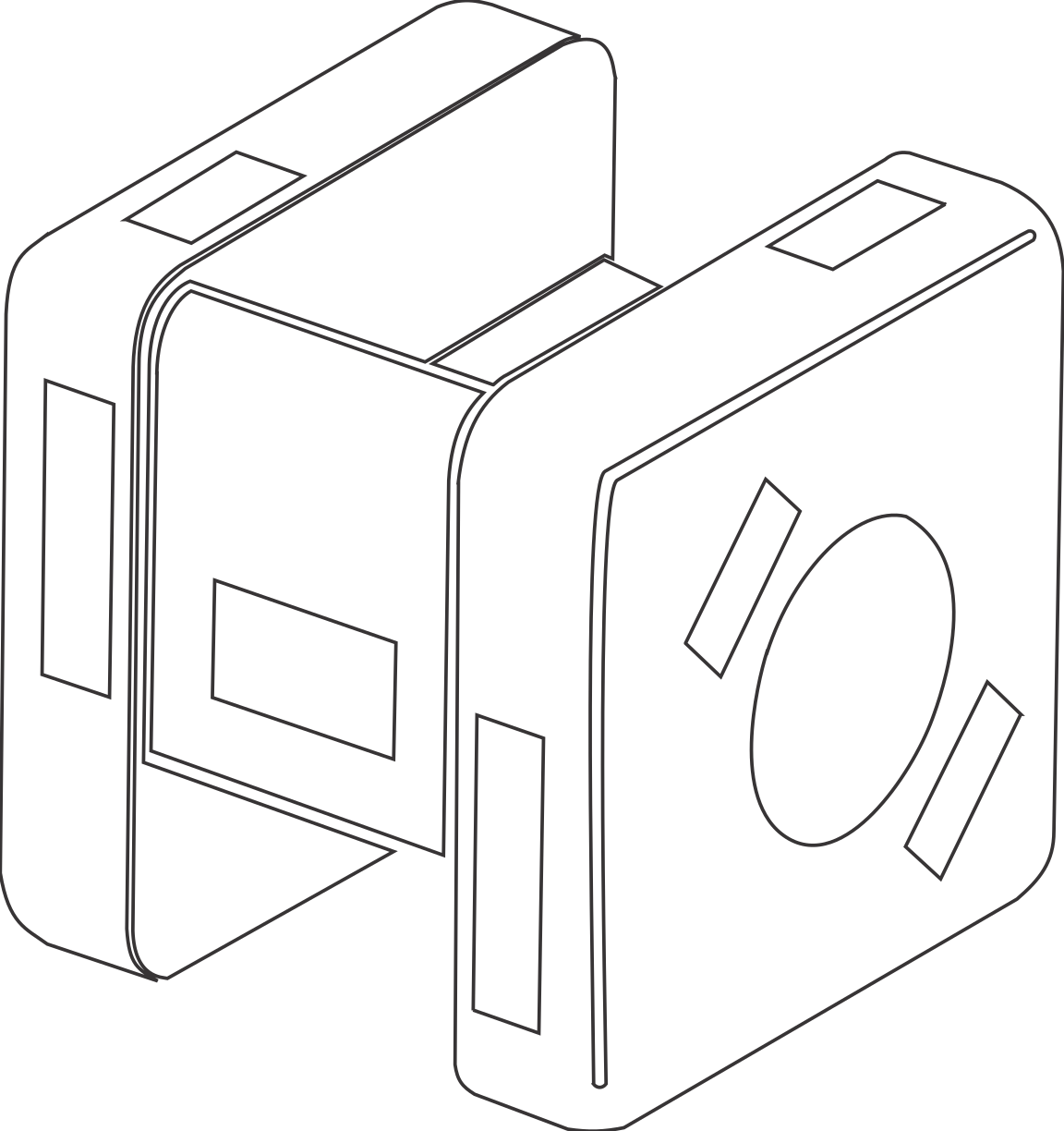
In 2015, I was asked to participate in the early stages of the Astrobee free-flyer project. Like SPHERES, Astrobee is free-flying robot/satellite that operates inside the ISS. It is a next-generation free-flyer that will replace SPHERES as a zero-gravity research facility for the advancement of sensing, end effectors, and human-robot interfaces for space exploration. This compact, 1-foot by 1-foot by 1-foot cube will help scientists and engineers develop and test technologies for use in zero-gravity, help the astronauts do their routine chores, and give flight controllers in Houston additional eyes and ears on spacecraft.
In June of 2015 I was promoted to being the SPHERES/Astrobee Facility Project Manager.
Astrobee launched to ISS in 2019. This work has involved every aspect of a spaceflight project from beginning to end. My responsibilities include the conception, planning, specification, design, analysis, development, installation, test, modification, operation, maintenance and use of data handling and computing systems for spacecraft.
With the experience gained in operating SPHERES for over 10 years, I was able to make contributions to the Astrobee requirements development, system design and development, infusion, and deployment of highly complex intelligent systems and component technologies. Astrobee is expanding the capabilities of tele-robotic space systems.
As the project manager for the SPHERES/Astrobee Facility, I have overseen both basic and applied research and leading-edge technology development in the field of intelligent adaptive systems. Just a selection of partnered research projects included;
- SPHERES-Slosh, an investigation led by NASA-KSC launch services program and Florida Institute of Technology visually analyzing the behavior of fluid slosh in microgravity
- SPHERES-Tether, an Airbus led investigation into the dynamics of tethered active objects in earth orbit for orbital debris removal applications
- RINGS, led by MIT and UMD to study electromagnetic propulsion and wireless power transfer
- UDP/HALO, led by MIT to study in-space satellite servicing
- VERTIGO, led by MIT to study vision based navigation
- Astrobatics, led by the Naval Post Graduate School to study propellantless motion using Astrobee’s perching arm
- Deep Audio Analytics, led by Astrobotic and BOSCH to study environmental audio characterization
- REALM-2 RFID logistics reduction is a project out of NASA JSC to integrate an RFID scanner on Astrobee to automate logistics tracking of ISS objects
- Gecko inspired Adhesive Gripper, a Stanford study on how Gecko inspired grippers could support in-space manipulation.
In 2016, a SPHERES unit on ISS experienced a propulsion failure. The failure mode presented an exceptionally difficult to diagnose problem unyielding to conventional investigation. The overall SPHERES thrust was reduced at intermitted and inconsistent times. I made the executive decision to down-mass the unit for further analysis in our NASA Ames lab. I formulated a research plan and hypotheses for why this hardware failure occurred. The solution ultimately required an unconventional and novel approaches to diagnostics. My team was responsible for discovering new tooling required for deconstructing the SPHERES unit to more closely examine the failing thrusters. We were successful in isolating and defining the critical problem with this SPHERES unit. We were also able to document our experience and expand the knowledge in our field of ISS Space Flight. Very few other ISS payloads have operated in space conditions as long as we have, over 10 years.
My duties have included building and expanding capabilities strategically aligned with the technical direction of NASA’s human space exploration goals. In many situations, this has required discovering, disseminating, and applying new or expanded knowledge. An example of this has been in the coordination and leadership of international partnerships. In 2017, JAXA demonstrated a free-flyer robot on ISS called Int-Ball. Its goals have been to provide over-the-shoulder video monitoring capabilities on ISS. In 2018, DLR/Airbus is scheduled to launch an ESA sponsored free-flyer called CIMON. CIMON is meant to provide an intelligent companion interface for astronauts augmented with IBM’s Watson AI technology. Both of these teams have been participants of the SPHERES/Astrobee Working group meetings. Discussion continues over potential opportunities in inter-operable technologies that would allow each other’s robotic systems to seamless interface with each other in flight operations. This inter-organizational dialog has significant implications on potential international partnership and coordination for deep space exploration technologies where spacecraft care-taker robots will play an important role. This spearheaded effort also exemplifies an arbitration between various international parties to generate agreement on common requirements and common goals.
I’ve also participated in evaluating proposals. This proposal evaluation has included reviewing over ten SBIR/STTR phase 1 and phase 2 proposals. I’ve also supported the NASA Research Announcement (NRA): NASA Fellowship Activity for 2017 and 2018.
I’ve been invited to give talks at various institutions about SPHERES, Astrobee, and Robotics research on ISS. Some included a Google Tech Talk in November of 2017l the World’s Fair Nano 2018 in San Francisco, and a Technical Interchange Meeting with the Japanese Space Agency, JAXA in January of 2018.
Microchip Technology Inc. - Intern
2003 - 2007 | Chandler, AZ
- Built, debugged, executed, and analyzed microcontroller test setup data resulting in a significant design win
- Authored three published application articles demonstrating the use of Microchip products for embedded systems development (involving both hardware and software)
- Developed and taught short courses on embedded systems signal conditioning and embedded feedback systems at Microchip 05 & 07 Technology Conferences
- As lead applications intern, I mentored three other interns in software development
- Accepted the lead in the planning, design, analysis, development, and test of a microcontroller data acquisition system for ESD robustness testing utilizing high voltage instruments. This project also involved acquiring, reducing, computing, and producing statistical data products that highlighted product performance
IBM - Co-op
Summer 2002/2006/2007 | Austin, TX
- Supported the maintenance, configuration, modification, installation, test, and operation of IBM Enterprise Storage Server (ESS) mainframe computer systems
- Operated Unix/AIX data systems
- Power 7 VMX/Altivec Performance Verification
- Supported industry leading Power 7 servers for data handling and computing
- Power 6 Server Software and Firmware Bring-up installation and test
- Worked on improving processes and establishing procedures for Co-op training and on-boarding
- Participated in computer engineering Co-op mentorship program
Education
Arizona State University
2001 - 2009 | Tempe, AZ
Electrical Engineering Bachelors and Masters degree
Job Related Training
- Adaptive Controls course at Santa Clara University
- ITAR Training at NASA Ames
- MMOC/IVODS Console training
- Lead awareness training
- Chemical Hygiene
- Hazardous waste essentials
- HAZcom
- ESD and NASA IPC J-STD-001ES Solder Certified
- COMPRESSED GAS SAFETY
- CRYOGENIC SAFETY
- INTRODUCTION TO CMMI COURSE
- Conflict Management for High Performing Teams
- ARC EXPORT CONTROL AWARENESS TRAINING
- ETHICS FOR NASA EMPLOYEES (2017)
- FOSTERING COMMERCE, UNDERSTANDING POLICY, AND THE ROLE OF THE ISS
- APPEL-ADVANCED PROJECT MANAGEMENT AND ADVANCED SYSTEMS ENGINEERING
- ISS Program Guidance and Best Practices for Handling Sensitive Data
- PRINCIPLES OF SUCCESS IN SPACEFLIGHT
Publications
- Benavides, J. (2004), ‘Using the EUSART on the PIC16F688’ (AN944), Application Note, Microchip Technology Inc., Used for real-time baud rate/bandwidth determination.
- Benavides, J. (2005), ‘Robo-Kit: A Low Cost Kit for Robotics Research’, Technical Poster presentation, sponsored by Fulton Undergraduate Research Initiative (FURI), Presented to ASU Dean’s advisory committee and at MAES IS&CF 2005.
- Benavides, J. (2005), ‘Low Cost System Identification Tool’, Technical Report, Senior Design. For use within a laboratory setting, Intended Application: Electrical Networks.
- Benavides, J.; Lourens, R. (2005), ‘Using the Microchip Ultra Low-Power Wake-up Module’ (AN879), Application Note, Microchip Technology Inc. Used to prolong battery life within embedded systems.
- Benavides, J. (2005), ‘929 SCE Signal Conditioning In The Embedded World’, Presentation, Microchip MASTERs Conference, Microchip Technology Inc.; Over 100 industry engineers in attendance
- Benavides, J. (2006), ‘1019 NUM Numerical Methods on the PIC Micro’, Presentation, Microchip MASTERs Conference, Microchip Technology Inc.
- Benavides, J. (2007), ‘Efficient Fixed-Point Trigonometry Using CORDIC Functions For PIC16F’(AN1061), Application Note, Microchip Technology Inc.
- Benavides, J. (2007), ‘11082 PID Closed Loop Control on a 16F PICmicro’, Presentation, Microchip MASTERs Conference, Microchip Technology Inc., Control of a cart-inverted pendulum system using a Microchip Microcontroller
- Rodriguez, A.; Dickeson, J.; Cifdaloz, O.; Kelkar, A.; Vogel, J.; Soloway, D.; McCullen, R.; Benavides, J. & Sridharan, S. (2008), ‘Modeling and Control of Scramjet-Powered Hypersonic Vehicles: Challenges, Trends, and Tradeoffs’, AIAA Guidance, Navigation and Control Conference and Exhibit, Honolulu, Hawaii, Aug. 18-21,
- Benavides, J. ‘Design and Rapid Prototyping of Robust Fault-Tolerant Embedded Control Systems Using Field Programmable Gate Arrays (FPGAs)’, Masters Thesis, Arizona State University, May 2009.
- Dickeson, J. J.; Rodriguez, A. A.; Sridharan, S.; Benavides, J. & Soloway, D. (2009), ‘Decentralized Control of an Airbreathing Scramjet-Powered Hypersonic Vehicle’, AIAA Guidance, Navigation, and Control Conference.
- Rodriguez, A. A.; Dickeson, J. J.; Sridharan, S.; Korad, A.; Khatri, J.; Benavides, J.; Soloway, D.; Kelkar, A. & Vogel, J. M.(2009), ‘Control-Relevant Modeling, Analysis, and Design for Scramjet-Powered Hypersonic Vehicles’, AIAA/DLR/DGLR International Space Planes and Hypersonic Systems and Technologies Conf..
- Soloway, D.; Rodriguez, A. A.; Dickeson, J. J.; Cifdaloz, O.; Benavides, J.; Sridharan, S.; Kelkar, A. & Vogel, J. M.(2009), ‘Constraint Enforcement for Scramjet-Powered Hypersonic Vehicles with Significant Aero-Elastic-Propulsion Interactions”American Control Conference’, American Control Conference, Submitted to 2009 ACC.
- Ishihara, A; Nguyen, N; Luo, Y; Benavides, J; Kaneshige, J (2012), ‘A Robust Initialization Scheme for a Lateral Trajectory Optimization Problem with Time of Arrival Windows’, AIAA Infotech@aerospace
- Kaneshige, J; Panda, R; Hardy, G; Steglinski, M; Sharma, S; Benavides, J (2012), ‘Tactical Flight Management Concept for Trajectory Based Operations’, AIAA Infotech@aerospace
- Cornell, J (2013), ‘Researchers Test Control Algorithms for NASA SPHERES Satellites with a MATLAB Based Simulator’, MathWorks User Story
- Kaneshige, J; Benavides, J; Sharma, S; Panda, R; Steglinski, M. (2014), ‘Implementation of a Trajectory Prediction Function for Trajectory Based Operations’, AIAA Atmospheric Flight Mechanics Conference
- Martinez, Andres and Benavides, Jose Victor and Ormsby, Steve L. and GuarnerosLuna, Ali (2014), ‘SPHERES Facility’, NASA Fact Sheet
- Benavides, Jose (2014), ’ SPHERES National Lab Facility’, NASA In-Space Inspection Technology Workshop (ISIW 2014); 15-16 Jul. 2014; Houston, TX; United States
- Barlow, J. and Benavides, J. and Hanson, R. and Cortez, J. and Le Vasseur, D. and Soloway, D. and Oyadomari, K. 12-Jul-16 ISS Robotic Student Programming ISS R&D Conference; 12-14 Jul. 2016; San Diego, CA; United States
- Barlow, Jonathan and Benavides, Jose and Provencher, Chris and Bualat, Maria and Smith, Marion F. and Mora Vargas, Andres 16-Jul-17 Astrobee Guest Science International Space Station Research and Development Conference (ISS R&D 2017); 17-20 Jul. 2017; Washington, DC; United States
- Benavides, Jose 23-Aug-17 SPHERES: Synchronized, Position, Hold, Engage, Reorient, Experimental Satellites: SPHERES/Astrobee Working Group (SAWG) SPHERES/Astrobee Working Group; 23 Aug. 2017; Moffett Field, CA; United States
- Benavides, Jose and Smith, Marion F and Wheeler, Dawn and Fluckiger, Lorenzo 31-Aug-17 Astrobee Guest Science Guide NASA Technical Report
- Benavides, Jose V. 15-Nov-17 SPHERES and Astrobee: Space Station Robotic Free Flyers, Google Tech Talk; 15 Nov. 2017; Mountain View, CA; United States
Additional Information
Scholarships
- GEM Fellowship (2006-2007)
- Intel Outstanding Arizona Student Scholarship (2005)
- NSF funded Computer Science, Engineering, Mathematics, and Science (CSEMS) Scholarship (2005)
- MAES (Mexican American Engineers and Scientists) Industry Scholarship - sponsored by Northrop Grumman (2004)
- Daniel E. Noble scholarship through the ASU Fulton School of Engineering (2004)
- MAES Founders Scholarship (2003)
- MEP Summer Bridge Program Scholarship (2001)
- Intel Math/Science/Technology Academy (2000)
Leadership and Outreach
- Co-Founder and Electrical Designer for High School F.I.R.S.T.(For Inspiration and Recognition of Science and Technology) Robotics Team
- Volunteer FIRST Phoenix regional tournament referee for three years
- Past President, Vice President, Web Master, and founding member of ASU MAES (Mexican American Engineers and Scientists) for 3 years
- Helped organize the 2003 MAES National Symposium and Career Fair
- Helped organize and run ASU MAES High School Science Extravaganza
- Volunteered, Yuri’s Education Day 2011 Student Inspiration Opportunities
- Volunteered, NASA education outreach booth, Moffett Field founders day 2009, 2010
- Volunteered at San Jose State University Annual SOLES Science Extravaganza for High School Students 2011, 2012, 2017, 2018
- Annual Synopsis championship Santa Clara Valley Science and Engineering Fair (SCVSEFA), AIAA judge 2011, 2012, 2013, 2015, 2016, 2017, 2018
- MAES ASU chapter talk, “How to make effective Posters”
- Yuri’s Education Day 2011 Student Inspiration Opportunities
- Volunteered at Noche de Ciencias, SHPE (2012)
- Volunteer judge, Poster Science Fair, Arbuckle Elementary, San Jose, CA, 3/1/2018
- Volunteer, Annual Mathematics Engineering Science Achievement (MESA) Day for High School Students, 2015, 2017, 2018
- NASA Ames Job Shadow Opportunity for community college students, 3/9/2018
- Event Speaker, Worlds Fair Nano, Pier 48, San Francisco, 2018
- Annual “Evening with NASA”, Arbuckle Elementary, San Jose, CA, 2016, 2017, 2018
- NASA Ames Research Center Community College Aerospace Scholars (NCAS) Mentor 2016, 2017
Skills
- 68K & PIC Assembly Language
- Windows, Mac OS, Linux
- Linux/Unix Scripting
- MS Office, Latex, VIM
- JAVA, HTML, VHDL, C/C++, MATLAB programming
- Matlab/Simulink Real-Time Workshop, S-Function programming
- Good writing and communications skills, along with the ability to work well both individually and within a multidisciplinary team
- Salsa Dancing